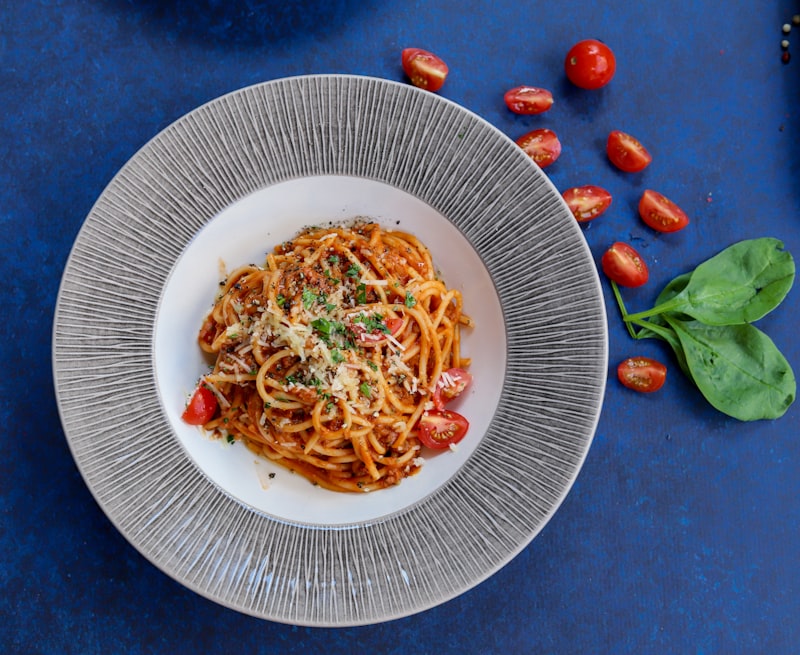
-
1
Wash the duck pieces, remove all visible fat and set aside for cicciolli.
-
2
Pat dry.
-
3
In a thick-bottomed casserole or Dutch oven, heat the olive oil until almost smoking over medium-high heat.
-
4
Season the duck pieces with salt and pepper and cook until brown on all sides, 10 to 12 minutes.
-
5
Remove the duck pieces to a plate and add the onion, carrot, garlic, celery, and sage to the casserole and cook over low heat until softened, 7 to 9 minutes.
-
6
Add the wine, tomatoes and chicken stock and bring to a boil.
-
7
Add the duck pieces, then lower the heat, cover, and simmer for 1 hour.
-
8
Remove the duck pieces, and when cool enough to handle pull all meat off the bones.
-
9
Return the meat to the pot and simmer uncovered 30 minutes, or until quite thick.
-
10
Season with salt and pepper and set aside.
-
11
Divide the prepared pasta dough into 3 evenly-sized balls.
-
12
Roll each ball out to the thinnest setting on a pasta rolling machine.
-
13
Cut the pasta into 2-inch squares, and roll each square around a dowel, corner to corner, to form quills.
-
14
Place the garganelli on a sheet tray dusted with semolina, cover with a damp towel and set aside.
-
15
Bring 6 quarts of water to a boil and add 2 tablespoons salt.
-
16
In a 12 to 14-inch saute pan, place enough ragu to coat but not overwhelm the pasta and toss over medium heat to heat through.
-
17
Drop the garganelli in the boiling water and cook 2 minutes, until tender yet al dente.
-
18
Drain the pasta, reserving the water, and add the pasta to the ragu.
-
19
Toss over high heat 2 minutes to coat, adding a splash of the pasta cooking water if necessary to keep the sauce at the proper consistency.
-
20
Divide the pasta among 4 warmed pasta bowls, grate Parmigiano over each bowl and serve immediately.
-
21
Mound 3 1/2 cups of the flour in the center of a large wooden cutting board.
-
22
Make a well in the middle of the flour and add the eggs and the olive oil.
-
23
Using a fork, beat together the eggs and oil and begin to incorporate the flour, starting with the inner rim of the well.
-
24
As you expand the well, keep pushing the flour up from the base of the mound to retain the well shape.
-
25
The dough will come together when half of the flour is incorporated.
-
26
Start kneading the dough with both hands, using the palms of your hands.
-
27
Once you have a cohesive mass, remove the dough from the board and scrape up and discard any leftover bits.
-
28
Lightly reflour the board and continue kneading for 6 more minutes.
-
29
The dough should be elastic and a little sticky.
-
30
Wrap the dough in plastic and allow to rest for 30 minutes at room temperature.
-
31
Roll or shape as desired.